
Registration open · You can register and start the training content at any time, and progress at your own pace
Training Program for the IBT® Pathway | 40 Hours
Start your path to the International Behavior Therapist (IBT®) credential
A 40-hour professional training program that covers the educational content required for the International Behavior Therapist (IBT®) pathway, combining recorded content, practical applications, and live review and follow-up sessions, within a flexible online learning experience that takes each trainee’s experience and progress into account
Choose between a Guided Learning path or Flexible Progression based on your experience, with the same content, assessment, and completion requirements
From $175 · Pay in full or in two installments · Start right away
Note: completing the 40-hour program fulfills the training requirement for the IBT® pathway, but it does not award the IBT® credential automatically. The credential is issued by IBAO® after all eligibility, practice, supervision, and assessment requirements set by the awarding body are completed

What does the program include?
- 32 hours of recorded learning content
- 8 hours of live reviews
- Case studies and practical applications
- Quizzes and interim assessments
- Practice exams simulating the board exam in Arabic and English
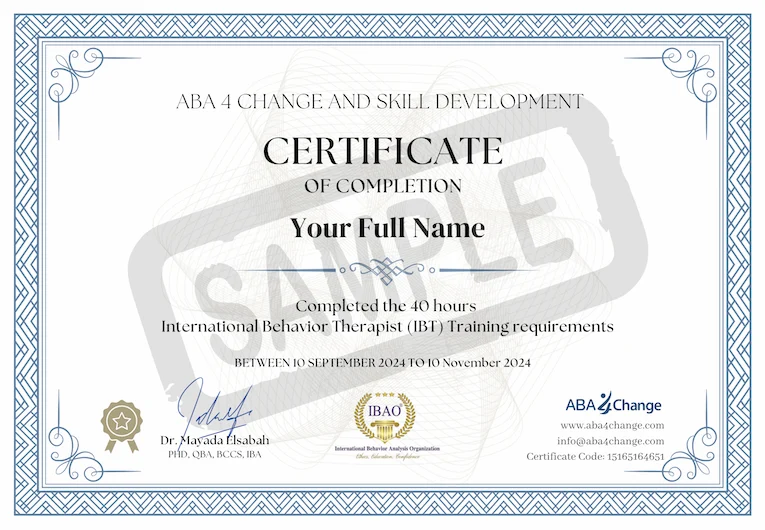
- 40-hour certificate of completion
How do you become an International Behavior Therapist?
The IBT credential, its requirements, and the exam explained
The Challenge
Looking for a clear starting point in ABA?
Not all learners start from the same place. That’s why we help you understand the requirements of the IBT® pathway and identify the right starting point for you, then progress through content, practice, and assessment according to your experience and needs.
01
Lots of information… but no clear place to start
You may read and watch a lot about ABA, but without a structured learning path it can be hard to know where to begin and how to move from core concepts to hands-on practice.
02
You know the theory… but how do you apply it in a real situation?
Knowledge alone isn’t enough for practice. You need training that helps you analyze the situation, choose the right response, and apply skills with confidence within the limits of your professional role and under supervision
03
There are many requirements, and you need a clear path
The IBT® pathway includes different stages and requirements. We help you understand them and put them in a clear order, so you know where to start and what you need to complete at each stage.
04
You want your certificate to reflect real skill
Our goal isn’t just to complete the content, but to help you understand behavior, apply what you learn, and make responsible professional decisions within the limits of your role and under supervision.
That’s why we designed the 40-hour IBT® training program to give you a clear, flexible path that starts from the right point for your experience and takes you from knowledge to practice and building professional competence.
The program combines structured content, practical applications, case studies, and review and assessment, while helping you understand the requirements of the IBT® pathway and progress at a pace that suits your experience and needs.
Two learning paths, one quality standard:
Choose between the Guided Learning Path and the Flexible Progression Path, both committed to the same mandatory content, learning outcomes, and assessment and completion requirements.
Professional Definition
What is an International Behavior Therapist (IBT®)?
A practitioner who provides direct behavioral support under supervision, takes part in implementing behavior plans, collects data, and supports skill acquisition within the limits of their role and professional competence.
International Behavior Therapist (IBT®) is a professional pathway for practitioners who provide direct behavioral support under supervision and apply behavioral skills and principles within the limits of their professional role.
The program prepares you to complete the 40-hour training requirement for the IBT® pathway
When you successfully complete the program, you receive a 40-hour training certificate of completion from ABA4Change Academy, as part of the pathway toward the IBT® credential issued by IBAO®.
The program focuses on building the core knowledge and skills needed for supervised practice in educational settings, support and intervention centers, and other related professional settings.
Completing the 40-hour program does not award the IBT® credential automatically. To obtain the IBT® credential from IBAO, you must complete the awarding body’s other requirements and apply according to its official procedures.
Approved Content Provider (ACP) with IBAO®
By the end of the training course
You’ll develop core skills for supervised behavioral practice
01
Understand what lies behind behavior
Clearly identify the target behavior, recognize the factors associated with it, and understand its function within a plan supervised by a behavior analyst
02
Collect data accurately and confidently
Use appropriate methods to record and measure behavior in an organized way, supporting progress monitoring and data-based decisions.
03
Implement the plan as designed
Learn to carry out intervention procedures according to the approved plan and under supervision, distinguishing between structured implementation and attempts that aren’t based on data.
04
Support the acquisition of new skills
Use strategies such as prompting, reinforcement, and shaping in a structured way to support skill acquisition and gradually increase independence
05
Handle challenging behaviors with confidence
Learn how to respond to difficult behaviors in a more organized and professional way, focusing on safety, understanding the function of behavior, and teaching appropriate alternatives within the approved plan and under supervision.
06
Communicate effectively with the family and the support team
Learn to communicate professionally with the family and team members, share observations and data clearly and respectfully, and support consistent implementation of the agreed strategies under the specialist’s supervision
07
Carry out your role competently and responsibly
Apply skills within the limits of your professional role and under supervision, document your work accurately, and ask for guidance when you need it, while committing to ethical and professional practice.
08
Prepare for assessment with confidence
Practice with models and questions that simulate the nature of the assessment, with a structured review that helps you identify your strengths and the areas that need more development before you move on to the official steps.
Note: the practice tests are part of ABA4Change’s preparation for review and readiness, and they are separate from any official assessment or exam conducted by the awarding body or an approved supervisor.
Training Content
From knowledge to practice: your learning journey starts here
The program content moves from core concepts to hands-on practice, through connected units that help you build knowledge and skills step by step, with applications and assessments that reinforce learning.
You complete all the same units and requirements, while the pace of progress can vary depending on the learning path you choose
01 Understanding Developmental Disabilities and Disorders Stage one
In this unit, you’ll learn about the core characteristics of some developmental disorders and disabilities a behavior practitioner may work with, and how they may appear in everyday practice.
- Autism spectrum disorder (Autism Spectrum Disorder – ASD)
- Intellectual disabilities (Intellectual Disabilities)
- Down syndrome (Down Syndrome)
- Attention-deficit/hyperactivity disorder (ADHD)
- Taking individual differences and support needs into account
02 Behavior Basics Stage two
- Increasing and decreasing behavior.
- Reinforcement (Reinforcement)
- Extinction (Extinction)
- Motivating operations (Motivating / Establishing Operations)
- Discriminative stimulus (Discriminative Stimulus – SD)
- Schedules of reinforcement (Schedules of Reinforcement)
- Conditioned reinforcers and token systems (Conditioned Reinforcers / Token Systems)
03 Data Collection and Measuring Behavior Stage three
- Preparing for data collection and organizing the recording process
- Measuring behavior frequency
- Measuring behavior duration.
- Measuring latency
- Partial and whole interval recording.
- Using permanent products of behavior where appropriate
- Organizing data and displaying it graphically to track change
04 Assisting with Assessment Procedures Stage four
- Preference assessments (Preference Assessments)
- Assisting with functional behavior assessment procedures (Functional Behavioral Assessment)
- Assisting with language and functional skills assessments
- Understanding the IBT’s role in assessment under the specialist’s supervision, rather than conducting the assessment independently
05 Teaching Skills and Skill Development Stage five
- Following teaching protocols and plans.
- Discrete trial training DTT
- Natural environment teaching NET
- Verbal behavior Verbal Behavior
- Task analysis Task Analysis
- Discrimination and choice
- Prompting strategies Prompting
- Skill maintenance Maintenance
- Skill generalization Generalization
06 Handling Challenging Behaviors Stage six
- Functions of behavior: recognizing the functions of behavior, the importance of linking intervention to function, and distinguishing between interventions that match the function and those that don’t
- Antecedent modifications: using changes before the behavior to reduce the likelihood of problem behavior, including choice, behavioral momentum, and noncontingent reinforcement NCR
- Differential reinforcement: understanding and using DRA, DRI, and DRO according to the approved plan
- Functional communication training (FCT): supporting the individual in learning an appropriate communicative response that serves the same function in a more adaptive way
- Extinction in practice: understanding how it’s applied according to the function of behavior, its possible behavioral effects, and being prepared for a temporary increase in the behavior, while respecting ethical use and client rights
07 Professionalism and Ethics Stage seven
Professional, ethical practice that respects privacy and role boundaries and promotes effective communication with the supervisor, the family, and the team, while taking cultural differences and neurodiversity into account.
- Understanding the IBT role: knowing the limits of the professional role and working within your scope of competence
Trainer
Why learn with Dr. Mayada Elsabah?
Because the training isn’t limited to explaining concepts; it connects knowledge, professional decision-making, and hands-on practice in real situations.
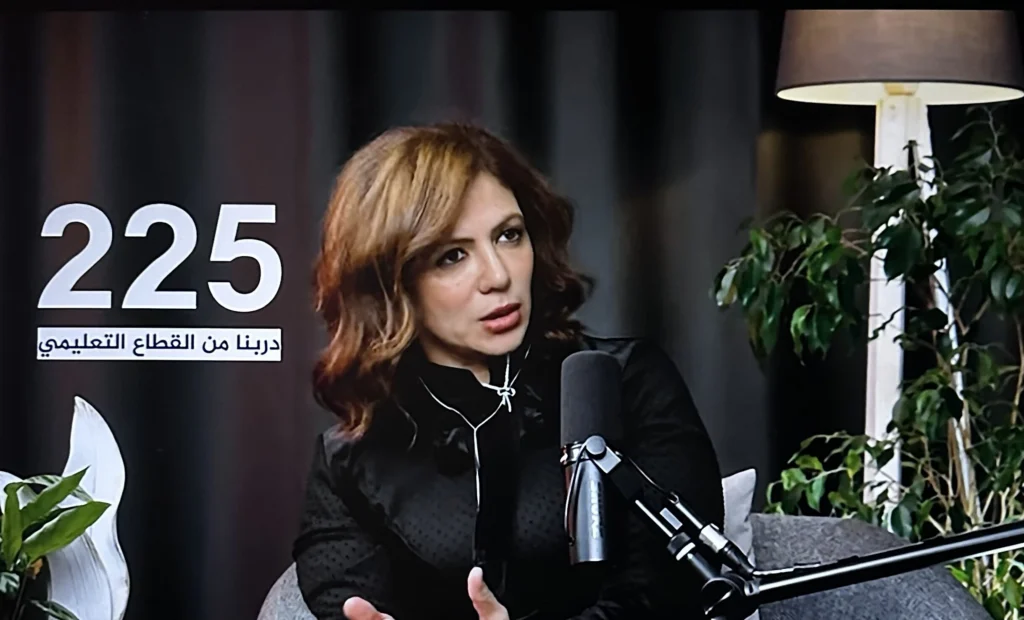
Dr. Mayada Elsabah combines an academic background in child psychology with applied experience in behavior analysis, education, and working with children and families in a variety of educational and professional settings.
That’s why the training focuses on helping you understand concepts, analyze situations, and apply what you learn in an organized, ethical way within the limits of your professional role.
So you won’t just learn concepts from her; you’ll practice turning them into decisions and practices that make a difference in the field.
Dr. Mayada Elsabah
Founder & CEO – ABA4Change Academy
Child Psychology Specialist | Credentialed Behavior Analyst
- PsyD
- QBA
- IBA
- BCCS
Academic Qualifications
PhD in Child Psychology, Master’s in Clinical Psychology, and Master’s in International Education.
A multidisciplinary academic background combining child psychology, mental health, and learning and education, supporting an integrated understanding of a child’s needs, behavior, and development.
QBA · IBA · BCCS
International professional credentials in behavior analysis, behavioral practice, and related knowledge fields
Experience training hundreds of professionals
She has trained hundreds of teachers, practitioners, and caregivers through applied programs that connect knowledge with real situations and challenges in the workplace.
More than 10 years of professional experience
Experience across settings and cultures
Professional and educational experience across a variety of school, community, and international settings
“My goal isn’t just to complete 40 training hours, but for you to leave the program able to understand what you’re learning, make mindful professional decisions, and apply your skills practically and ethically under supervision.”
Dr. Mayada Elsabah
Start from your current experience… and progress at the pace that suits you
Wherever you’re starting from… you’ll find a path that supports your progress
01
The Guided Path
Guided Learning Path
Suited to those who prefer learning in organized steps with a clear sequence, and regular follow-up that helps them build knowledge and skills gradually and complete the program requirements with confidence
Suggested pace: about 10 weeks, with recorded content, practical applications, and assessments and live review sessions.
02
The Flexible Progression Path
Flexible Progression Path
Suited to trainees with prior experience or who can progress faster, with the option to complete content and assignments at their own pace and join the review sessions appropriate to the stage they’ve reached.
Both paths follow the same mandatory content, training hours, learning outcomes, assessments, and completion standards; the only difference is the pace of progress and the level of structured support.
Who is this program for?
- Beginners in applied behavior analysis (ABA) who want to build a structured professional foundation before starting fieldwork.
- Direct behavioral support practitioners who work with children or individuals under a specialist’s supervision and want to develop their knowledge and applied skills.
- Teachers and teaching assistants who need a better understanding of behavior, data collection, and supporting skill acquisition in the classroom.
- Special education teachers and inclusion teams working with children with developmental disorders or different educational needs.
- Staff in autism and early intervention centers who want to develop their skills in implementing behavioral and educational plans under supervision.
- Support and rehabilitation specialists and specialist assistants whose roles include implementing behavioral programs or strategies directly.
- Students and graduates of psychology, education, special education, and related human services who want to explore an applied career path in ABA.
- Professionals with prior practical experience in ABA who want to complete structured training covering the 40-hour requirement for the IBT® pathway.
- Staff in schools, centers, and community programs who need practical skills in handling behavior, collecting data, supporting learning, and communicating with the team and the family.
- Professionals who want to move into an applied role in behavior analysis within the limits of the IBT role and under appropriate professional supervision.
This program is right for you if you:
- Want to complete the training required for the IBT® pathway within a structured program.
- Want to move from theoretical knowledge to practice under supervision.
- Are ready to complete the mandatory content, applications, and required assessments.
- Are looking for a learning pace that suits your experience, while keeping the same completion and quality standards.
It may not be the right path for you if you:
- Don’t want to complete the other requirements set by the credential’s awarding body.
- Expect to receive the professional IBT® credential automatically as soon as you complete the 40-hour program.
- Are looking for a path that lets you skip mandatory content or assessments because of your prior experience.
- Are looking for independent practice without professional supervision.
Not sure? Contact us, and we’ll help you work out whether IBT® is the most suitable path for your goal and your current experience.
This path suits me – I want to register
Help me choose a path
The IBT® Roadmap
From registration to credential in clear steps
Some pathway requirements can be completed in parallel; after registering and signing a supervision agreement, you can start supervised practice while completing the required training
01
Eligibility check and registration
Confirm that you meet the required educational qualification, then create a candidate account with IBAO®, pay the fees, and agree to the Code of Ethics. IBAO currently requires a high school diploma or equivalent.
02
Choose a qualified supervisor and sign a supervision agreement, then begin completing the pathway requirements. Supervised practice hours can begin as soon as the agreement is in place, alongside the training.
03
Completing training and building competence
Complete 40 hours of approved training covering the required IBT® content, with practical applications and assessments that help build core knowledge and skills
→ This is the educational stage ABA4Change provides
04
Completing the credential requirements
Before applying for the exam, the candidate completes IBAO’s other requirements, which currently include:
300 hours of supervised practice
10 hours of supervision — one hour for every 30 hours of practice
Two Candidate Skills Tests
4 hours of pre-certification continuing education
Then passing the online IBT® exam.
05
Passing the two skills tests (CST)
During supervised practice, your supervisor assesses your performance on two different sets of practical skills related to your role and to what you’ve been trained and supervised on. The supervisor designs the assessment, conducts it, and documents that you passed, in line with IBAO® requirements.
06
Pre-certification continuing education
Complete 4 hours of continuing education (Pre-Certification CEUs) before receiving the IBT® credential:
1 hour of ethics
1 hour of diversity and cultural awareness
2 hours on other ABA topics.
07
Passing the IBT® exam
After completing the training, practice and supervision, skills test, and continuing education requirements, the candidate sits the online IBT® exam according to IBAO® procedures
08
File review and issuing the IBT® credential
After all requirements are completed and the exam is passed, IBAO® reviews the candidate’s file and documents, and once the requirements are met, it issues the IBT® credential
The journey doesn’t end here… what happens after you receive the credential?
Receiving the IBT® credential is the beginning of ongoing professional development. Under current IBAO requirements, the certification cycle lasts two years, and continuing education and supervision requirements must be met to maintain and renew your credential status
01 — Continuing Education
8 CEU hours in each two-year certification cycle
Currently including:
2 hours of ethics
2 hours of diversity and cultural awareness
4 hours on ABA topicsThat’s an average of 4 continuing education hours per year
02 — Ongoing Professional Supervision
IBT® practice must continue under the supervision of a qualified supervisor registered with IBAO, with a minimum of one hour of supervision each month while providing ABA services. Supervision can be individual or group, in person or remote, according to the approved conditions
03 — Maintaining Your Credential Status and Renewal
Keep documentation of your continuing education hours and supervision sessions, and keep an active supervisor on your account. Recertification happens every two years according to the IBAO requirements in force at the time of renewal.
Note: if an IBT has no registered supervisor, or receives no supervision for two consecutive months, the account status may change to Dormant, and ABA services may not be provided or the credential renewed until the status is reactivated according to IBAO procedures.
Check Your Eligibility
Are you eligible to start the IBT® pathway?
Six quick answers tell you where you stand today, exactly what you’re missing, and the right step for you now.
Are you 18 or older?
Do you hold at least a high school diploma or equivalent?
Do you hold a valid behavior analysis credential from another body?Such as QBA, BCBA, or equivalent
Can you set aside regular time each week for training?
Do you have a place where you can practice with clients?A school, center, home, or early intervention program
Do you have a qualified supervisor registered with IBAO®?
Get the full checklist and pathway tracker (free PDF)
Two printable pages: the checklist with a scoring key, a map of the pathway steps with a date box for each step, a gap-closing table, and 4 questions to ask any training provider before you pay.
Your checklist is ready: Download the checklist (PDF)
Print it and answer the items in 3 minutes. If “Not yet” comes up for any item and you’d like us to go over it with you, message us on WhatsApp.
We use your details only to send the checklist and follow up on your inquiry. Privacy Policy
The result is a guide based on IBAO®’s currently published requirements, which may change. The final authority is IBAO®, which exclusively issues the IBT® credential.
Graduate Experiences
What changed in their practice after completing the 40 hours?
“By God’s grace, I’d like to share my certificate of completion for the 40-hour International Behavioral Therapist (IBT) course, the first and essential step toward the IBT credential. My sincere thanks and gratitude to Dr. Mayada Elsabah, whose experience and knowledge I benefited from enormously.”

Abdullah MohamedSpecialist · IBT program graduate
“Thank you to the ABA4Change team, led by Dr. Mayada Elsabah and under the supervision of Dr. Michael Mueller, for their trust in me and the opportunity they gave me, and for the invaluable insights and training they provided.”

Esraa NagibIBT program graduate
Fees
Choose the starting point that suits you best
IBT Training – 40 Hours
$175 $225Original price and the remaining $87.50 after 30 days
Start anytime and learn at your own pace, with regular live sessions for practice and review.
- 40 hours in total: 32 hours of recorded content + 8 hours of live practice
- Recorded, structured content
- Weekly times on a rotation system (recurring sessions you choose from to suit your stage)
- Case studies and a practice exam
- 40-hour certificate of completion
The Most Complete Pathway
Training + Supervision Package
$350 $450Original price and the remaining $175 after 30 days
Move from studying the content to applying it with confidence under professional supervision.
- Everything in the Flexible Training package
- 10 hours of professional supervision
- Follow-up on applying skills
- Reviewing cases and data
- Conducting and documenting the two skills tests (CST)
- Ethical and professional guidance
We accept online payment





✓ Full refund guarantee
Attend the first session, and if you find the program isn’t right for you, you can request a full refund within 24 hours of attending it, in line with our Refund Policy.
All payments are processed securely through Amazon Payment Services
Frequently Asked Questions
Your questions, answered
What’s the difference between the 40-hour certificate and the IBT® credential?
The 40-hour certificate proves you’ve completed the educational component of the pathway. The IBT® credential is issued by IBAO® after the other requirements are completed: supervised practice, supervision hours, Candidate Skills Testing, and the exam.
Is the training live or recorded?
The program includes 8 hours of live practice and review within a hybrid learning system, while you study the rest of the recorded content flexibly on your own schedule. You can watch the recordings at any time, then ask your questions during the next live session.
What is the refund policy?
You can request a full refund within 24 hours of attending the first session if you find the program isn’t right for you. After that period, fees are not refundable. Details are in our Refund Policy.
Show all questions (12 questions)
Is ABA4Change an approved content provider with IBAO®?
Yes. ABA4Change is currently listed in the official directory of Approved Content Providers (ACPs) with IBAO®.
This means it is approved to deliver the educational content required for the IBT® pathway. The IBT® credential itself is issued exclusively by IBAO® after the trainee completes all credential requirements and passes the exam
Do I need prior experience?
No, prior experience in ABA is not required to join the program; the content starts from the basics and builds toward hands-on practice. It also suits teachers, practitioners, and people already working in schools, centers, intervention programs, and support services who want to develop their practice
What happens if I miss a session?
Because the program is delivered through hybrid learning, your progress won’t stop if you miss a live session. You can watch its recording, complete the content and digital activities flexibly, and then ask your questions through the support group or during the next live session.
How long is the training?
The program includes 40 training hours over a suggested 10 weeks, and you can progress faster or slower depending on your time, through hybrid learning that combines recorded content you can study flexibly with live sessions for discussion, practice, and case studies.
What do the 10 supervision hours and 300 practice hours mean?
While completing 300 hours of field practice, the trainee receives one hour of supervision for every 30 hours of practice, for a total of 10 supervision hours, in line with IBAO® requirements.
Supervision is provided by a qualified specialist registered with IBAO®, and includes performance follow-up, case discussion, feedback, and skill development. Each supervision session must be documented using the approved forms in the trainee’s account
Are IBAO® exam fees included?
No. The listed price covers only ABA4Change’s training and the services described in the chosen package. Candidate registration fees, exam fees, and any other fees for the IBT® credential are paid directly to IBAO® according to its fees and policies in force at the time of application.
What language is the training in?
The training is taught in clear, practical Arabic, using core scientific terminology in English, to help you understand the content and handle ABA terminology and IBT® requirements with confidence.
Are there payment or installment options?
Yes, you can pay the full program fee, or pay in installments through us. For customers in Egypt, installment plans over longer periods are also available through various methods if your bank offers long-term installment payments. The fee and available payment options are shown during registration on the website; contact us for details.
When can I start the training?
You can register and start the training content at any time, and progress at your own pace. The live review and practice sessions are held weekly on a rotation system (recurring sessions), so you can book the session that suits the stage you’ve reached.
How long does my access to the course content last?
There is no set time limit on your access to the recorded course content after you register; it remains available for you to follow and revisit whenever suits you.
Do the fees include Candidate Skills Testing and supervision hours?
The CST assessment is carried out during the supervised practice period, after the trainee’s registration with IBAO is active and the supervision agreement is signed. The registered supervisor selects two skills for assessment and documents the result and uploads the required forms. The “Training + Supervision Package” includes 10 supervision hours with a supervisor registered with IBAO®, plus conducting, documenting, and uploading the two required CST assessments; these are not included in the basic “IBT Training – 40 Hours” package.
What is the total cost of obtaining the IBT® credential?
ABA4Change’s fees ($175 or $350, depending on the package) cover only the training and the services described in the chosen package. Candidate registration fees, exam fees, and other fees for the IBT® credential pathway are set and collected directly by IBAO® according to its fee schedule and policies in force at the time of application, so a fixed total can’t be given in advance.
Are you ready to start your path to the IBT® credential?
Start building the core knowledge and skills you need to advance your career, through structured, flexible training that takes your experience and starting point into account.